Wednesday, January 30, 2013

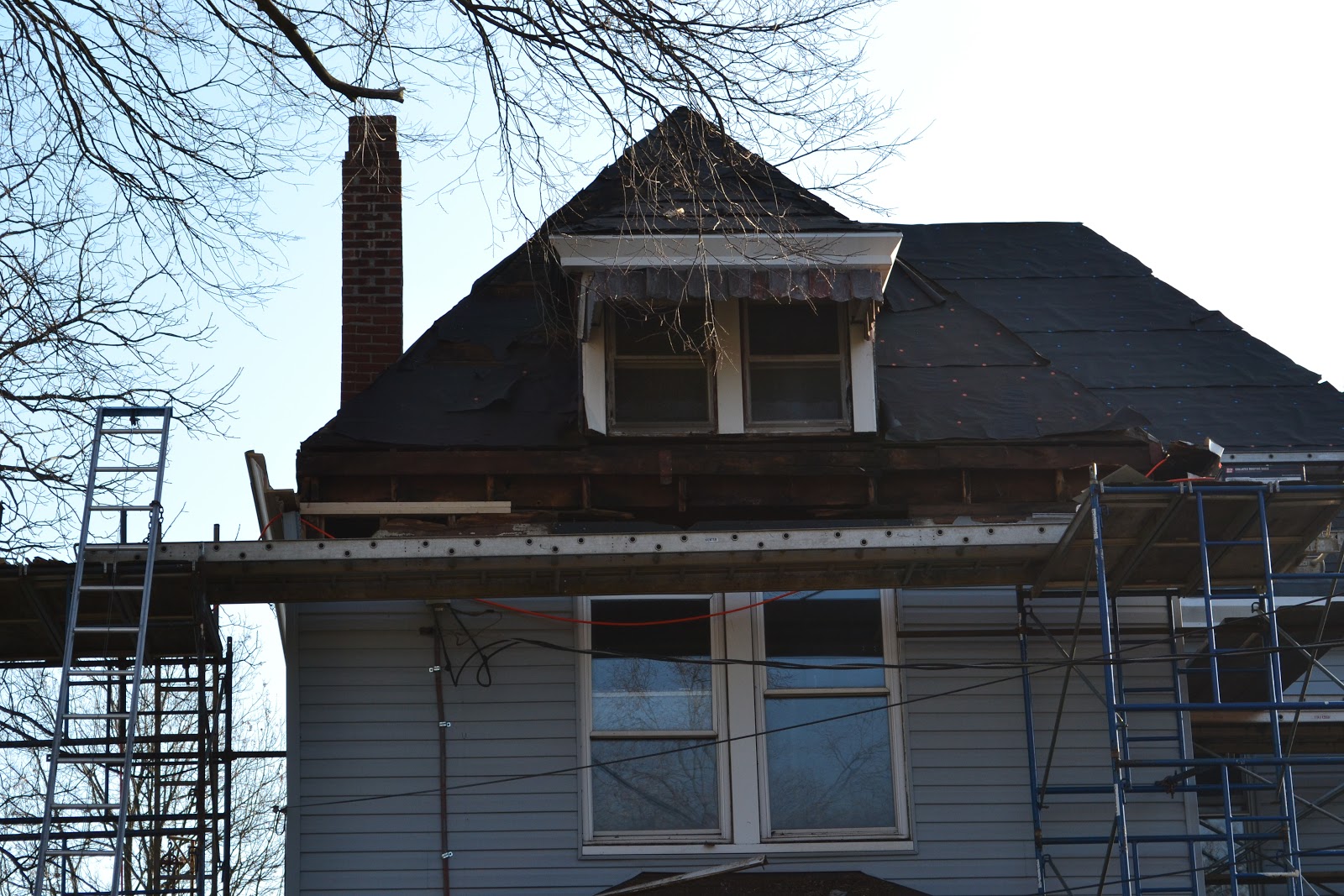
It's Finally Not Raining Inside Our House! (aka we have a Roof, Windows, & Siding)


The new front door is installed. We were going for an industrial look. Just kidding. 
My dad is applying his fabulous carpentry skills to restoring the original gigantic door 
so this one is just temporary


The masons have started to repair the 6 fireplaces.  
They are just going to be decorative, but they still need to look fabulous! 


Remember our front porch roof that looked as if it was ready to fall off the house?


It had to be jacked over 4 inches to bring it back to level.


Unfortunately, that means that now the roof is pulling away from the house. 


We're attempting to pick a paint color


and ended up being inspired by this house by Smith & Vansant Architects


But we are going to go a little more Green/Grey. Here's a couple mock ups:


What do you think?


Friday, January 4, 2013

Innovating an 1885 House: LEED Innovation & Design credits


The LEED for Homes Innovation & Design Process (ID) credit category rewards and encourages projects in three major areas:

ID 1: Integrated Project Planning encourages project planning and design to improve the coordination and integration of the various elements in a green home.
      ID 2: Durability Management Process applies simple quality assurance measures during design and construction that improve the home’s resilience to weather, pests, and other environmental issues.
      ID 3: Innovative or Regional Design creates an opportunity for projects to earn credit for implementing strategies or measures not addressed in the current LEED for Homes Rating System. Credits can be earned for innovative designs, exemplary performance, or regional best practices that can be shown to produce quantifiable environmental and human health benefits.

The category includes 3 prerequisites and 11 possible points. The prerequisites that apply to the Burns house and credits we chose to pursue are:

ID1.1 Preliminary Rating (prerequisite) – This entailed holding a preliminary meeting with the LEED for Homes Green Rater to go over the project and identify potential credits from the LEED checklist. The LEED Green Rater acts as both a LEED consultant and the project’s LEED inspector.  Our Green Rater is Sanyog Rathod of Sol Design + Consulting.  He definitely knows his stuff, and is very cooperative. I highly recommend him.

ID 1.2 Integrated Project Team (1point) – The idea here is that a well selected project team meets throughout the design and construction process to better achieve good design and implementation. Our project team included:

Sara Aschliman (me) of dwellbeing
Project Owner / General Contractor / Architect / LEED AP +Homes

Brent Niese  of dwellbeing
Architect / LEED AP + Homes

HVAC / Geothermal designer

Chris Dwyer of Sol Design &Consulting
Energy Modeling / Building Technology Testing

ID 1.3 Professional Credentialed with Respect for LEED for Homes (1 point) – Building are certified, but professionals are accredited.  In this case both Brent and I have earned our LEED AP+Homes accreditation which means that we have LEED for Homes experience and have passed the required tests.  Participating on the project team earns us 1 point.

ID1.5 Building Orientation for Solar Design (1 point) – Design the home such that all of the following requirements are met:
a) The glazing area on the north- and south-facing walls of the building is at least 50% greater than the sum of the glazing area on the east- and west facing walls.
b) The east-west axis of the building is within 15 degrees of due east-west.
c) The roof has a minimum of 450 square feet of south-facing area that is oriented appropriately for solar applications.
d) At least 90% of the glazing on the south-facing wall is completely shaded (using shading, overhangs, etc.) at noon on June 21 and unshaded at noon on December 21.

Since houses in the 1800’s were built to take advantage of natural light, it not so coincidentally happens that the existing house sits within the 15 degrees of a due east-west and that there are nearly twice as many windows on the north and south sides of the house than the east and west.  The existing old growth deciduous trees on the perimeter of the site, provide the shade in the summer, yet allow the light to pass thru in the winter. Here's a pic of our south-facing wall in the winter showing 90% unshaded windows. In June we will see how much shade the trees provide. 


ID2.1 Durability Planning (prerequisite) – It is a LEED requirement to evaluate the home based on location and construction type, identify potential climate, topographic, and pest related risks, and develop strategies to combat these risks to create a more durable building.  Durability strategies that we identified in the Burns house include:
  
Exterior Moisture:
Seal all plumbing, electrical, and other penetrations of walls and floors, and seal joints.
Continuous drainage plane behind exterior wall cladding fully sealed at all penetrations
Raise paper covered gypsum board 1/2" above concrete slab
Fully flash all window and door openings
Installed system for diverting roof water from house (e.g. gutters of overhangs in dry climates)
No. 30 roof felt underlayment minimum
Reduced ice dams: No non-airtight recessed light fixtures in insulated flat ceilings; no non-airtight recessed fixtures in insulated cathedral ceilings.

Interior Mosture:
Nonpaper-faced backer board used in all tubs, showers, and spa areas.
Water-resistant flooring in the kitchen, bathroom, laundry rooms, and spa areas.
Water-resistant flooring within 3 feet of all exterior doors.
Drain and drain pan installed for any tank water heaters in or over living spaces
Drain and drain pan OR single-throw supply valve installed for any clothes washers in or over living spaces
Conventional clothes dryers exhausted directly to outdoors
Whole house ventilation and local kitchen and bathroom exhaust systems that comply with ASHRAE Std. 62.2
Use highly durable materials in wet areas

Heat Loss:
Exposed concrete slab edge insulated.
Install insulation per Thermal Bypass Checklist
All ductwork within conditioned space
Window: U-factor ≤ 0.40
Exterior doors to be weather sealed
Basement walls insulated

Pests:
Seal external cracks, joints, etc. with caulking and install pest-proof screens
Use solid concrete foundation walls or pest-proof masonry wall design
keep all wood 12" above grade

Radon:
Provide minimum 4" diameter PVC pipe to vent Radon gas from under slab to roof or exterior wall.
Provide junction box at roof end of pipe for future exhaust fan.
Use solid concrete floor


ID2.2 Durability Management (prerequisite) – supplemental to ID2.1, is it required that the builder inspect construction to ensure that the identified durability measures our implemented.

ID2.3 Third-Party Durability Management Verification (3 points) – As an added level of insurance, the Green Rater may inspect the project to verify the durability measures.

ID3.1 Innovation 1: Advanced Utility Tracking (1 point)  – To earn this credit we enrolled the Burns house in the USGBC’s Building Performance Partnership and gave it permission to track our utilities for their database.  This is a pilot credit which means that the USGBC is exploring the potential for adding it the rating system.

ID3.2 Innovation 2: Street Network Intersection Density (1 point) – This is also a pilot credit.  Similar to the Preferred Locations, Community Service & Transit, and Access to Open Space credits offered in the Locations and Linkages Category, like the name implies, Street Network Intersection Density rewards projects that are located in in areas with many street intersections as research shows that this can cut down on gas usage and therefore carbon emissions.


ID3.3 Innovation 3:  Exemplary Performance in Materials and Resources 2.2 Environmentally Preferable Products (1 point) – Because our project reuses much of the existing structure which is considered both recycled and local material, it earned more points than were available in the category. Therefore this exemplary performance earns credit in this innovation and design category.

Wednesday, December 19, 2012

All I want for Christmas is Windows!

I was waiting to post until after all the windows were in, housewrap was up, and the roof was finished,
but as it feels like that is NEVER going to happen, here are a few pictures to tide you over!


With Tyvek housewrap installed and cement board siding creeping up one side, 
the front of the house is starting to show promise::


but the back of the house is another story . . .


HVAC is installed, though not running yet. Plumbing & electric are both currently being roughed-in.


 our piano will live in this bay window:


and our Christmas tree will go in front of these windows . . . next year.


Tuesday, December 4, 2012

LEED for Homes in a Nutshell

LEED is an acronym for Leadership in Energy and Environmental Design. It is an internationally recognized green building program.:

LEED is a voluntary, consensus-based, market­-driven program that provides third-party verification of green buildings. From individual buildings and homes, to entire neighborhoods and communities, LEED is transforming the way built environments are designed, constructed, and operated. Participation in the voluntary LEED process demonstrates leadership, innovation, environmental stewardship and social responsibility. LEED provides building owners and operators the tools they need to immediately impact their building’s performance and bottom line, while providing healthy indoor spaces for a building’s occupants.1

The LEED system is divided into several different subcategories called Rating Systems. Each Rating System is geared towards the unique needs of a project or building type.  In our case LEED for Homes was the obvious choice.  The rating system is really a checklist of credits which are opportunities and directions  for achieving certification. Other than the prerequisites and minimum point thresholds in certain areas, it is really a choose-your-own-adventure type system with projects earning various points for fulfilling credit requirements.  

In total there are 18 prerequisites and 67 credits available. I will go into greater depth into the credits our Burns project pursued in future posts, but for now, here is an overview of the eight credit categories:
1. Innovation & Design (ID) Process.Special design methods, unique regional credits, measures not currently addressed in the Rating System, and exemplary performance levels. 
2. Location & Linkages (LL). The placement of homes in socially and environmentally responsible ways in relation to the larger community. 
3. Sustainable Sites (SS). The use of the entire property so as to minimize the project’s impact on the site. 
4. Water Efficiency (WE). Water conservation practices, both indoor and outdoor. 
5. Energy & Atmosphere (EA). Energy efficiency, particularly in the building envelope and heating and cooling design 
6. Materials & Resources (MR). Efficient utilization of materials, selection of environmentally preferable materials, and minimization of waste during construction. 
7. Indoor Environmental Quality (EQ). Improvement of indoor air quality by reducing the creation of and exposure to pollutants. 
8. Awareness & Education (AE). The education of homeowner, tenant, or multifamily building manager about the operations and maintenance of the green features of a LEED Home.2

Pending the points total, projects can achieve various levels of certification: Certified, Silver, Gold, or Platinum.  In the city of Cincinnati, projects that achieve LEED certification are eligible for a real estate tax abatement Since our Burns house is not in the city limits, we do not get any of these financial benefits, but are nonetheless proud of our anticipated achievement. Stay tuned for updates on our LEED progress, and for more information check out the video and link below!


https://new.usgbc.org/leed/rating-systems/homes

***

1 https://new.usgbc.org/leed

2  LEED for Homes Reference Guide 2010 

Wednesday, November 21, 2012

It has to get worse before it gets better . . .


With renovation projects it often has to get worse before it gets better, and this house is definitely no exception! Though we still have people asking us everyday why we would want to get into this, Brian and I are thoroughly excited with the progress and potential!

 Since construction has begun, I had to get my sign up!


Roofing has started,


And surprise! (not really) We discovered that our box gutters were pretty much gone.


along with some of the walls behind them! yikes!


so we are having them rebuilt all from scratch.


We have begun to tear down the old vinyl to prep for our new cement board siding.
No, the old red clapboard below was not salvageable.


Since the house was built way before plywood existed, the exterior wall and roof sheathing is actually large solid wood boards, some of them over 16" wide.


attic sheathing 


The geothermal wells have been dug.

What a mess! But we will appreciate it when we get our reduced utility bills!


The new openings in the living & dining rooms have been framed, and HVAC ductwork has been installed.


as well as the framing for our new master bath:


and attic family room. Can you picture the pool table here? We can!


Full geothermal and HVAC post coming soon for those of you interested in the technical / mechanical details.


Wednesday, October 17, 2012

Demolition Derby!

Our 4' x 8' front door - one of the only things we are keeping in the house!


The front staircase is also a keeper!


and it actually leads to the 2nd floor now!


future living room:


future dining room:


what not to do to a bearing wall:


or to floor joists. Yikes!


the future kitchen:


porch full o scrap


future master bedroom:


Jonah's future bedroom:


Isaac's future bedroom:


2nd floor hallway


future family room:


future office:


3rd floor bathroom:


moonshine anyone?


A very big Thank You goes to the Building Value demo crew for all their hard work salvaging our gigantic wood trim for reuse, and especially for removing 5 dumpsters full of plaster, lath, and mummified squirrels.

Building Value is a nonprofit social enterprise that salvages reusable materials for sale to the public. Their efforts help the environment, reduce the cost of disposal, and give architectural gems a second life. They are a subsidiary of the Easter Seals and are an all around super organization. 
If you are interested in their deconstruction services or their architectural resale store, please check out their website here: http://www.buildingvalue.org/